
CIPS L5M4 Practice Exams
Last updated on Oct 21,2026- Exam Code: L5M4
- Exam Name: Advanced Contract and Financial Management
- Certification Provider: CIPS
- Latest update: Oct 21,2026
SIMULATION
Describe three categories of stakeholders and a method for how you could map different types of stakeholders within an organization (25 points)
Stakeholders are individuals or groups impacted by or influencing an organization.
Below are three categories, explained step-by-step:
Internal Stakeholders
Step 1: Define the Category
Individuals or groups within the organization, such as employees, managers, or owners.
Step 2: Examples
Staff involved in procurement or executives setting strategic goals.
Outcome:
Directly engaged in operations and decision-making.
External Stakeholders
Step 1: Define the Category
Entities outside the organization affected by its actions, such as customers, suppliers, or regulators.
Step 2: Examples
Suppliers providing materials or government bodies enforcing compliance.
Outcome:
Influence or are influenced externally by the organization.
Connected Stakeholders
Step 1: Define the Category
Groups with a contractual or financial link, such as shareholders, lenders, or partners.
Step 2: Examples
Investors expecting returns or banks providing loans.
Outcome:
Have a vested interest tied to organizational performance.
Part 2: Method for Mapping Stakeholders
Step 1: Choose a Framework
Use the Power-Interest Matrix to map stakeholders based on their influence (power) and concern (interest) in the organization.
Step 2: Application
Plot stakeholders on a 2×2 grid:
High Power, High Interest: Manage closely (e.g., executives).
High Power, Low Interest: Keep satisfied (e.g., regulators).
Low Power, High Interest: Keep informed (e.g., employees).
Low Power, Low Interest: Monitor (e.g., minor suppliers).
Assess each stakeholder’s position using data (e.g., influence on decisions, dependency on outcomes).
Step 3: Outcome
Prioritizes engagement efforts based on stakeholder impact and needs.
Exact Extract Explanation
The CIPS L5M4 Study Guide covers stakeholder categories and mapping:
Categories: "Stakeholders include internal (e.g., employees), external (e.g., suppliers), and connected (e.g., shareholders) groups" (CIPS L5M4 Study Guide, Chapter 1, Section 1.7). Mapping: "The Power-Interest Matrix maps stakeholders by their influence and interest, aiding prioritization in contract and financial management" (CIPS L5M4 Study Guide, Chapter 1, Section 1.7).
This supports effective stakeholder management in procurement.
Reference: CIPS L5M4 Study Guide,
Chapter 1: Organizational Objectives and Financial Management.
SIMULATION
A manufacturing organization is looking into the option of benchmarking. Describe how a benchmarking exercise can be conducted and common reasons for benchmarking failure that the organization should be aware of (25 points)
A benchmarking exercise follows a structured process to ensure meaningful outcomes:
Step 1: Define Objectives
Identify goals (e.g., reduce production costs, improve lead times) and select metrics (e.g., cost per unit).
Step 2: Choose Benchmarking Type
Decide on internal (e.g., between plants), competitive (e.g., rival firm), or best-in-class (e.g., industry leader).
Step 3: Collect Data
Gather internal performance data and external benchmarks via research, surveys, or industry reports.
Step 4: Analyze Gaps
Compare data to identify disparities (e.g., higher costs than peers) and root causes.
Step 5: Implement Improvements
Develop and execute an action plan based on findings (e.g., adopt new technology).
Step 6: Monitor Results
Track progress and adjust strategies to sustain gains.
Outcome:
Systematically improves manufacturing performance.
Part 2: Common Reasons for Benchmarking Failure
Step 1: Lack of Clear Objectives
Vague goals (e.g., “improve efficiency”) lead to unfocused efforts and poor results.
Step 2: Poor Data Quality
Inaccurate or incomplete data (e.g., outdated competitor stats) skews comparisons.
Step 3: Resistance to Change
Staff or management reluctance to adopt new practices stalls implementation.
Outcome:
Undermines the exercise’s effectiveness.
Exact Extract Explanation
The CIPS L5M4 Study Guide outlines benchmarking processes and pitfalls:
Process: "Benchmarking involves setting objectives, selecting comparators, collecting and analyzing data, implementing changes, and monitoring outcomes" (CIPS L5M4 Study Guide, Chapter 2, Section 2.6).
Failures: "Common failures include unclear objectives, unreliable data, and organizational resistance" (CIPS L5M4 Study Guide, Chapter 2, Section 2.6).
This is critical for manufacturing firms optimizing supply chains.
Reference: CIPS L5M4 Study Guide, Chapter 2: Supply Chain Performance Management.
SIMULATION
What is the difference between competitive and non-competitive sourcing? (12 marks)
In which circumstances may a non-competitive sourcing approach be more appropriate? (13 marks)
Advanced Contract and Financial Management study guide, these methods impact cost, supplier relationships, and contract outcomes. Below is a step-by-step comparison: Definition and Process:
Competitive Sourcing: Involves inviting multiple suppliers to bid for a contract through a formal process (e.g., tendering, RFQs). Suppliers compete on price, quality, and other criteria.
Example: Issuing a tender for raw materials and selecting the supplier with the best offer. Non-Competitive Sourcing: Involves selecting a supplier without a competitive bidding process, often through direct negotiation or sole sourcing.
Example: Directly negotiating with a single supplier for a specialized component.
Key Differences:
Competition: Competitive sourcing drives competition among suppliers, while non-competitive sourcing avoids it, focusing on a single supplier.
Transparency: Competitive sourcing is more transparent, with clear criteria for selection, whereas non-competitive sourcing may lack visibility and increase the risk of bias.
Cost Focus: Competitive sourcing often secures lower prices through bidding, while non-competitive sourcing prioritizes relationship or necessity over cost.
Time and Effort: Competitive sourcing requires more time and resources (e.g., tender management), while non-competitive sourcing is quicker but may miss cost-saving opportunities.
Part 2: In which circumstances may a non-competitive sourcing approach be more appropriate? (13 marks)
Non-competitive sourcing can be more suitable in specific situations where competition is impractical or less beneficial. Below are key circumstances: Unique or Specialized Requirements:
When a product or service is highly specialized and only one supplier can provide it, non-competitive sourcing is necessary.
Example: Sourcing a patented technology available from only one supplier.
Urgency and Time Constraints:
In emergencies or when time is critical, competitive sourcing’s lengthy process may cause delays, making non-competitive sourcing faster.
Example: Sourcing materials urgently after a supply chain disruption (e.g., a natural disaster).
Existing Strategic Relationships:
When a strong, trusted relationship with a supplier exists, non-competitive sourcing leverages this partnership for better collaboration and reliability.
Example: Continuing with a supplier who has consistently delivered high-quality materials.
Low Value or Low Risk Purchases:
For small, low-risk purchases, the cost of a competitive process may outweigh the benefits, making non-competitive sourcing more efficient.
Example: Sourcing office supplies worth £500, where tendering costs exceed potential savings.
Exact Extract Explanation
Part 1: Difference Between Competitive and Non-Competitive Sourcing
The CIPS L5M4 Advanced Contract and Financial Management study guide addresses sourcing approaches in the context of strategic procurement, emphasizing their impact on cost and supplier relationships. It describes competitive sourcing as "a process where multiple suppliers are invited to bid," promoting transparency and cost efficiency, while non-competitive sourcing is "direct engagement with a single supplier," often used for speed or necessity. Detailed Comparison:
The guide highlights that competitive sourcing aligns with "value for money" by leveraging market competition to secure better prices and terms. For example, a tender process might reduce costs by 10% through supplier bids.
Non-competitive sourcing, however, is noted as "less transparent" but "faster," suitable when competition isn’t feasible. It may lead to higher costs due to lack of price comparison but can foster stronger supplier relationships.
L5M4 stresses that competitive sourcing requires "formal processes" (e.g., RFQs, tenders), increasing administrative effort, while non-competitive sourcing simplifies procurement but risks bias or favoritism.
Part 2: Circumstances for Non-Competitive Sourcing
The study guide identifies scenarios where non-competitive sourcing is preferable, particularly when "speed, uniqueness, or strategic relationships" outweigh the benefits of competition.
Unique Requirements: The guide notes that "sole sourcing is common for specialized goods," as competition is not viable when only one supplier exists.
Urgency: L5M4’s risk management section highlights that "time-sensitive situations" (e.g., emergencies) justify non-competitive sourcing to avoid delays.
Strategic Relationships: The guide emphasizes that "long-term partnerships" can justify non-competitive sourcing, as trust and collaboration may deliver greater value than cost savings.
Low Value Purchases: Chapter 2 suggests that for "low-value transactions," competitive sourcing may not be cost-effective, supporting non-competitive approaches.
Practical Application: For XYZ Ltd (Question 7), non-competitive sourcing might be appropriate if they need a unique alloy only one supplier provides or if a sudden production spike requires immediate materials.
Reference: CIPS L5M4 Study Guide, Chapter 2: Performance Management in Contracts, Section on Sourcing Strategies.
Additional
Reference: Chapter 4: Financial Management in Contracts, Section on Cost Efficiency and Risk Management.
SIMULATION
Explain what is meant by ‘supplier selection’ (25 marks)
Definition:
Supplier selection is the process of identifying, evaluating, and choosing suppliers based on predefined criteria to fulfill an organization’s procurement requirements.
It involves assessing potential suppliers’ capabilities, performance, and alignment with the buyer’s goals.
Purpose:
Ensures the selected supplier can deliver the right quality, quantity, and timing of goods or services while meeting financial and contractual expectations.
Aims to minimize risks (e.g., supply disruptions) and maximize value (e.g., cost efficiency, innovation).
Example: XYZ Ltd (Question 7) selects a raw material supplier based on cost, quality, and reliability.
Key Steps in Supplier Selection:
Identify Needs: Define the organization’s requirements (e.g., specific raw materials, delivery schedules).
Develop Criteria: Establish evaluation criteria (e.g., cost, quality, financial stability―see Questions 7 and 13).
Source Potential Suppliers: Use competitive (Question 16) or non-competitive sourcing to create a shortlist.
Evaluate Suppliers: Assess candidates against criteria using tools like scorecards or financial analysis.
Negotiate and Select: Choose the best supplier and negotiate contract terms.
Example: Rachel (Question 17) might shortlist suppliers for raw materials, evaluate them on price and delivery, and select the one offering the best overall value.
Importance in Contract Management:
Supplier selection directly impacts contract performance―choosing the wrong supplier can lead to delays, quality issues, or cost overruns.
It aligns with financial management by ensuring cost efficiency and risk mitigation, key L5M4 principles.
Example: Selecting a financially stable supplier (Question 13) reduces the risk of mid-contract failure.
Strategic Considerations:
Involves balancing short-term needs (e.g., immediate cost savings) with long-term goals (e.g., supplier innovation―Question 2).
May incorporate strategic sourcing principles (Question 11) to align with organizational objectives like sustainability or innovation.
Example: A company might select a supplier with strong innovation capacity to support future
product development.
Exact Extract Explanation
The CIPS L5M4 Advanced Contract and Financial Management study guide defines supplier selection as "the process of evaluating and choosing suppliers to meet organizational needs while ensuring value for money and minimizing risks." It is a foundational element of procurement, discussed extensively in the context of performance management, risk mitigation, and financial efficiency. The guide emphasizes that supplier selection is not just about cost but involves a "structured evaluation" to ensure suppliers deliver on quality, reliability, and strategic objectives.
Detailed Explanation
The guide outlines supplier selection as a multi-step process, starting with "defining requirements" and ending with "contract award." This structured approach ensures fairness and alignment with organizational goals.
Chapter 2 stresses that supplier selection should use "robust criteria" (e.g., cost, quality, financial stability―Question 7) to evaluate candidates, often through tools like weighted scorecards or financial analysis (Question 13).
The guide links supplier selection to financial management by noting its role in "cost control" and "risk reduction." For instance, selecting a supplier with a strong Current Ratio (Question 13) ensures they can meet short-term obligations, avoiding supply disruptions that could inflate costs.
It also highlights the strategic aspect, integrating concepts like innovation capacity (Question 2) and
industry analysis (Question 14) to select suppliers who support long-term goals, such as sustainability
or technological advancement.
Practical Application:
For Rachel (Question 17), supplier selection for raw materials involves defining needs (e.g., consistent steel supply), setting criteria (e.g., price, quality, delivery), shortlisting suppliers, evaluating them (e.g., via financial data), and choosing the best fit. This ensures her manufacturing operations run smoothly and cost-effectively.
The guide advises involving cross-functional teams (e.g., procurement, production, finance) to ensure criteria reflect organizational priorities, enhancing the selection process’s effectiveness.
Broader Implications:
Supplier selection impacts the entire contract lifecycle―poor selection can lead to performance issues, requiring corrective actions like supplier development (Question 3).
Financially, it ensures value for money by selecting suppliers who offer the best balance of cost, quality, and reliability, aligning with L5M4’s core focus.
The guide also notes that selection should be revisited periodically, as market conditions (Question
14) or supplier performance may change, requiring adjustments to maintain contract success.
Reference: CIPS L5M4 Study Guide, Chapter 2: Performance Management in Contracts, Section on Supplier Appraisal and Selection.
Additional
Reference: Chapter 4: Financial Management in Contracts, Section on Risk Management and Value Delivery.
SIMULATION
Describe the principles of Simultaneous Engineering (25 marks)
Below is a detailed step-by-step explanation of its principles:
Concurrent Task Execution:
Description: Activities such as design, testing, and production planning occur simultaneously rather than in a linear sequence.
Purpose: Speeds up the development process and reduces time-to-market by overlapping tasks that traditionally follow one another.
Example: Engineers design a product while production teams prepare manufacturing setups concurrently, rather than waiting for the design to be fully completed.
Benefit: Accelerates project timelines, aligning with financial goals of minimizing delays and associated costs.
Cross-Functional Collaboration:
Description: Involves integrating multidisciplinary teams (e.g., design, engineering, procurement, suppliers) from the outset of the project.
Purpose: Ensures all perspectives are considered early, minimizing errors, miscommunication, and rework later in the process.
Example: A procurement team collaborates with designers to ensure material choices are cost-effective and available, while manufacturing flags potential production challenges. Benefit: Enhances decision-making quality and reduces costly downstream adjustments.
Early Supplier Involvement:
Description: Suppliers are engaged at the start of the project to contribute expertise and align their capabilities with design and production requirements.
Purpose: Improves manufacturability, reduces lead times, and ensures supplier processes are integrated into the project plan.
Example: A supplier suggests alternative materials during the design phase to improve durability and lower costs.
Benefit: Strengthens buyer-supplier relationships and aligns with L5M4’s focus on collaborative contract management.
Iterative Feedback and Continuous Improvement:
Description: Feedback loops are built into the process, allowing real-time adjustments based on testing, supplier input, or production insights.
Purpose: Identifies and resolves issues early, ensuring the final product meets quality and cost targets.
Example: Prototype testing reveals a design flaw, which is corrected before full-scale production begins.
Benefit: Reduces waste and rework, supporting financial efficiency objectives.
Use of Technology and Tools:
Description: Leverages advanced tools like Computer-Aided Design (CAD), simulation software, and project management systems to facilitate concurrent work.
Purpose: Enables real-time data sharing and coordination across teams and locations.
Example: A shared CAD platform allows designers and suppliers to collaborate on a 3D model simultaneously.
Benefit: Enhances accuracy and speeds up communication, reducing project costs and risks.
Exact Extract Explanation
The CIPS L5M4 Advanced Contract and Financial Management study guide does not explicitly dedicate a section to Simultaneous Engineering, but its principles align closely with the module’s emphasis on efficient contract execution, supplier collaboration, and financial optimization. SE is implicitly referenced in discussions of "collaborative approaches" and "process efficiency" within supplier management and project delivery. The guide underscores the importance of integrating suppliers into contract processes to achieve value for money, a goal SE directly supports.
Principle 1: Concurrent Task Execution:
The guide highlights the need to "minimize delays in contract delivery" (Chapter 2), which SE achieves by overlapping tasks. This reduces the overall project timeline, a key financial consideration as prolonged timelines increase labor and overhead costs.
Context: For example, in a construction contract, designing the building while sourcing materials concurrently avoids sequential bottlenecks.
Principle 2: Cross-Functional Collaboration:
Chapter 2 emphasizes "team-based approaches" to ensure contract success. SE’s cross-functional principle mirrors this by uniting diverse stakeholders early. The guide notes that "effective communication reduces risks," which SE facilitates through integrated teams.
Financial Link: Early collaboration prevents costly redesigns, aligning with L5M4’s focus on cost control.
Principle 3: Early Supplier Involvement:
The guide advocates "supplier integration into the planning phase" to leverage their expertise (Chapter 2). SE formalizes this by involving suppliers from day one, ensuring their capabilities shape the project.
Example: A supplier’s early input on a component’s feasibility avoids later supply chain disruptions, reducing financial penalties or delays.
L5M4 Relevance: This supports the module’s theme of building strategic supplier relationships to enhance contract outcomes.
Principle 4: Iterative Feedback and Continuous Improvement:
The study guide stresses "proactive risk management" and "continuous monitoring" (Chapter 2). SE’s feedback loops align with this by catching issues early, such as a design flaw that could inflate production costs if undetected.
Financial Benefit: Early corrections minimize waste, supporting the guide’s focus on achieving value for money.
Principle 5: Use of Technology and Tools:
While not explicitly detailed in L5M4, the guide references "modern tools" for managing contracts efficiently (Chapter 4). SE’s reliance on technology like CAD or project management software enhances coordination, a principle that reduces errors and costs.
Example: Real-time updates via software ensure all parties work from the same data, avoiding misaligned efforts that could increase expenses. Broader Implications:
SE aligns with L5M4’s financial management goals by reducing time-to-market (lowering holding costs), improving quality (reducing defects), and optimizing resources (cutting waste).
It fosters a partnership approach, a recurring theme in the guide, where buyers and suppliers share risks and rewards. For instance, a shorter development cycle might allow both parties to capitalize on market opportunities sooner.
The guide’s focus on "whole-life costing" is supported by SE, as early collaboration ensures long-term cost efficiency (e.g., designing for maintainability).
Practical Application:
In a contract for a new product, SE might involve designers, suppliers, and production teams agreeing on specifications upfront, testing prototypes mid-process, and adjusting designs in real-time. This contrasts with traditional sequential methods, where delays and rework are common.
The guide suggests measuring success through KPIs like "time-to-completion" or "cost variance," which SE directly improves.
Reference: CIPS L5M4 Study Guide, Chapter 2: Performance Management in Contracts, Section on Collaborative Approaches and Supplier Integration.
Additional
Reference: Chapter 4: Financial Management in Contracts, Section on Efficiency and Cost Optimization.
SIMULATION
ABC Ltd is a manufacturing organization which operates internationally and buys materials from different countries. Discuss three instruments in foreign exchange that ABC could use (25 points)
Below are three FX instruments it can use, detailed step-by-step:
Forward Contracts
Step 1: Understand the Tool
A binding agreement to buy or sell a currency at a fixed rate on a future date.
Step 2: Application
ABC agrees with a bank to lock in an exchange rate for a material purchase in 6 months.
Step 3: Outcome
Protects against adverse currency movements, ensuring cost predictability.
Use for ABC:
Ideal for planning payments in volatile markets like the Euro or Yen.
Currency Options
Step 1: Understand the Tool
A contract giving the right (not obligation) to buy/sell currency at a set rate before a deadline.
Step 2: Application
ABC buys an option to purchase USD at a fixed rate, exercising it if rates worsen.
Step 3: Outcome
Offers flexibility to benefit from favorable rates while capping losses.
Use for ABC:
Useful for uncertain material costs in fluctuating currencies.
Currency Swaps
Step 1: Understand the Tool
An agreement to exchange principal and interest payments in one currency for another.
Step 2: Application
ABC swaps GBP loan payments for USD to match revenue from US sales, funding material purchases.
Step 3: Outcome
Aligns cash flows with currency needs, reducing FX exposure.
Use for ABC:
Effective for long-term international contracts or financing.
Exact Extract Explanation
The CIPS L5M4 Study Guide discusses FX instruments for managing international transactions: Forward Contracts: "Forwards fix exchange rates, providing certainty for future payments" (CIPS L5M4 Study Guide, Chapter 5, Section 5.2).
Currency Options: "Options offer protection with the flexibility to capitalize on favorable rate changes" (CIPS L5M4 Study Guide, Chapter 5, Section 5.3).
Currency Swaps: "Swaps manage long-term FX risks by aligning cash flows across currencies" (CIPS L5M4 Study Guide, Chapter 5, Section 5.4).
These tools are vital for ABC’s global procurement stability.
Reference: CIPS L5M4 Study Guide,
Chapter 5: Managing Foreign Exchange Risks.
SIMULATION
Apart from cost and quality, what other criteria could be used to assess a supplier to ensure they are a good fit for your organisation? Describe 5 criteria (25 marks)
Delivery Reliability:
Description: Measures the supplier’s ability to deliver goods or services on time and in full, often assessed through historical performance data or promised lead times.
Why Use It: Ensures supply chain continuity, avoiding production delays or stockouts that could increase costs or disrupt operations.
Example: A supplier with a 98% on-time delivery rate ensures Rachel’s manufacturing (Question 17) runs smoothly.
Assessment: Review past delivery records or negotiate contractual commitments (e.g., 5-day lead times).
Financial Stability:
Description: Evaluates the supplier’s economic health using financial data like profitability ratios, liquidity ratios, or debt levels (Question 13).
Why Use It: Reduces the risk of supplier insolvency, which could halt supply and lead to costly disruptions.
Example: A supplier with a Current Ratio of 1.8 and low Debt-to-Equity Ratio (0.4) is financially stable, minimizing risk for XYZ Ltd (Question 7).
Assessment: Analyze financial statements or use third-party credit reports (e.g., Dun & Bradstreet).
Innovation Capacity:
Description: Assesses the supplier’s ability to innovate in products, processes, or services, often measured by R&D investment or new product launches (Question 2).
Why Use It: Ensures the supplier can support future needs, such as developing sustainable materials or improving efficiency, aligning with long-term goals.
Example: A supplier with 5% of revenue in R&D might develop a new alloy, benefiting Rachel’s product innovation.
Assessment: Review patents, innovation programs, or collaborative projects with the supplier.
Sustainability and Ethical Practices:
Description: Examines the supplier’s commitment to environmental sustainability, social responsibility, and ethical standards (e.g., carbon footprint, labor practices).
Why Use It: Aligns with corporate social responsibility (CSR) goals and regulatory requirements, enhancing the organization’s reputation and compliance.
Example: A supplier with ISO 14001 certification (environmental management) supports XYZ Ltd’s sustainability goals.
Assessment: Check certifications, sustainability reports, or audit the supplier’s practices.
Capacity and Scalability:
Description: Evaluates the supplier’s ability to meet current demand and scale production if the organization’s needs grow (Question 7).
Why Use It: Ensures the supplier can support growth without disruptions, avoiding the cost of switching suppliers in the future.
Example: A supplier with spare capacity to increase production by 20% can support Rachel’s expansion plans.
Assessment: Conduct site visits or review production capacity data to confirm scalability.
Exact Extract Explanation
The CIPS L5M4 Advanced Contract and Financial Management study guide emphasizes a "holistic approach" to supplier assessment, beyond just cost and quality, to ensure suppliers deliver strategic and financial value. It highlights the need to evaluate suppliers on criteria that mitigate risks, support long-term goals, and align with organizational priorities, as seen in supplier selection (Question 18) and strategic sourcing (Question 11).
Detailed Explanation of Each Criterion:
Delivery Reliability:
The guide notes that "timely delivery is critical to operational efficiency." A supplier’s failure to deliver on time can lead to production stoppages, increasing costs―contrary to L5M4’s financial management goals. This criterion ensures supply chain stability. Financial Stability:
Chapter 4 stresses that "financial health assessment" (e.g., via ratios like Current Ratio―Question 13) is essential to avoid supplier failure. A financially unstable supplier risks disrupting contracts, impacting costs and operations.
Innovation Capacity:
The guide links innovation to "strategic value" (Question 2), noting that suppliers who innovate can reduce costs or improve products over time, supporting long-term competitiveness and financial efficiency.
Sustainability and Ethical Practices:
L5M4’s risk management section highlights "compliance with ethical and environmental standards" as a growing priority. Suppliers with poor practices can damage the buyer’s reputation or lead to legal issues, increasing financial risks.
Capacity and Scalability:
The guide emphasizes "future-proofing supply chains" by selecting suppliers who can grow with the organization. This avoids the cost of re-sourcing if demand increases, aligning with financial planning and operational continuity.
Practical Application for Rachel (Question 17):
Delivery Reliability: Ensures raw materials arrive on time for manufacturing, avoiding production delays.
Financial Stability: Confirms the supplier can sustain a 5-year contract without financial failure.
Innovation Capacity: Identifies a supplier who can develop sustainable materials, aligning with Rachel’s CSR goals.
Sustainability: Ensures the supplier meets environmental standards, reducing regulatory risks.
Capacity: Confirms the supplier can scale supply if Rachel’s production increases over time. Together, these criteria ensure the supplier is a good fit for Rachel’s organization, balancing operational needs with financial and strategic objectives.
Broader Implications:
The guide advises weighting criteria based on organizational priorities―e.g., a manufacturer might prioritize delivery reliability over innovation if production uptime is critical.
These criteria should be integrated into a supplier scorecard, as recommended by L5M4, to ensure a structured and transparent evaluation process.
Financially, they support value for money by selecting suppliers who minimize risks (e.g., disruptions, non-compliance) and maximize long-term benefits (e.g., innovation, scalability).
Reference: CIPS L5M4 Study Guide, Chapter 2: Performance Management in Contracts, Section on Supplier Appraisal and Selection.
Additional
Reference: Chapter 4: Financial Management in Contracts, Section on Risk Management and Strategic Value.
SIMULATION
Explain three different types of financial data you could collect on a supplier and what this data would tell you (25 marks)
Profitability Ratios (e.g., Net Profit Margin):
Description: Profitability ratios measure a supplier’s ability to generate profit from its operations.
Net Profit Margin, for example, is calculated as:

This data is typically found in the supplier’s income statement.
What It Tells You:
Indicates the supplier’s financial health and efficiency in managing costs. A high margin (e.g., 15%) suggests strong profitability and resilience, while a low or negative margin (e.g., 2% or -5%) signals potential financial distress.
Helps assess if the supplier can sustain operations without passing excessive costs to the buyer.
Example: A supplier with a 10% net profit margin is likely stable, but a declining margin over years might indicate rising costs or inefficiencies, posing a risk to contract delivery.
Liquidity Ratios (e.g., Current Ratio):
Description: Liquidity ratios assess a supplier’s ability to meet short-term obligations. The Current Ratio is calculated as:

This data is sourced from the supplier’s balance sheet.
What It Tells You:
Shows whether the supplier can pay its debts as they come due. A ratio above 1 (e.g., 1.5) indicates good liquidity, while a ratio below 1 (e.g., 0.8) suggests potential cash flow issues. A low ratio may signal risk of delays or failure to deliver due to financial constraints.
Example: A supplier with a Current Ratio of 2.0 can comfortably cover short-term liabilities, reducing
the risk of supply disruptions for the buyer.
Debt-to-Equity Ratio:
Description: This ratio measures a supplier’s financial leverage by comparing its total debt to shareholders’ equity:

This data is also found in the balance sheet.
What It Tells You:
Indicates the supplier’s reliance on debt financing. A high ratio (e.g., 2.0) suggests heavy borrowing, increasing financial risk, while a low ratio (e.g., 0.5) indicates stability.
A high ratio may mean the supplier is vulnerable to interest rate hikes or economic downturns, risking insolvency.
Example: A supplier with a Debt-to-Equity Ratio of 0.3 is financially stable, while one with a ratio of 3.0 might struggle to meet obligations if market conditions worsen.
Exact Extract Explanation
The CIPS L5M4 Advanced Contract and Financial Management study guide emphasizes the importance of financial due diligence in supplier selection and risk management, directly addressing the need to collect and analyze financial data. It highlights that "assessing a supplier’s financial stability is critical to ensuring contract performance and mitigating risks," particularly in strategic or long-term contracts. The guide specifically references financial ratios as tools to evaluate supplier health, aligning with the types of data above.
Detailed Explanation of Each Type of Data:
Profitability Ratios (e.g., Net Profit Margin):
The guide notes that profitability metrics like Net Profit Margin "provide insight into a supplier’s operational efficiency and financial sustainability." A supplier with consistent or growing margins is likely to maintain quality and delivery standards, supporting contract reliability.
Application: For XYZ Ltd (Question 7), a raw material supplier with a declining margin might cut corners on quality to save costs, risking production issues. L5M4 stresses that profitability data helps buyers predict long-term supplier viability, ensuring financial value. Liquidity Ratios (e.g., Current Ratio):
Chapter 4 of the study guide highlights liquidity as a "key indicator of short-term financial health." A supplier with poor liquidity might delay deliveries or fail to fulfill orders, directly impacting the buyer’s operations and costs.
Practical Use: A Current Ratio below 1 might prompt XYZ Ltd to negotiate stricter payment terms or seek alternative suppliers, aligning with L5M4’s focus on risk mitigation. The guide advises using liquidity data to avoid over-reliance on financially weak suppliers.
Debt-to-Equity Ratio:
The guide identifies leverage ratios like Debt-to-Equity as measures of "financial risk exposure." A high ratio indicates potential instability, which could lead to supply chain disruptions if the supplier faces financial distress.
Relevance: For a manufacturer like XYZ Ltd, a supplier with a high Debt-to-Equity Ratio might be a risk during economic downturns, as they may struggle to access credit for production. The guide recommends using this data to assess long-term partnership potential, a key financial management principle.
Broader Implications:
The guide advises combining these financial metrics for a comprehensive view. For example, a supplier with high profitability but poor liquidity might be profitable but unable to meet short-term obligations, posing a contract risk.
Financial data should be tracked over time (e.g., 3-5 years) to identify trends―e.g., a rising Debt-to-Equity Ratio might signal increasing risk, even if current figures seem acceptable.
In L5M4’s financial management context, this data ensures cost control by avoiding suppliers likely to fail, which could lead to costly delays or the need to source alternatives at higher prices. Practical Application for XYZ Ltd:
Profitability: A supplier with a 12% Net Profit Margin indicates stability, but XYZ Ltd should monitor for declines.
Liquidity: A Current Ratio of 1.8 suggests the supplier can meet obligations, reducing delivery risks.
Debt-to-Equity: A ratio of 0.4 shows low leverage, making the supplier a safer long-term partner.
Together, these metrics help XYZ Ltd select a financially sound supplier, ensuring contract
performance and financial efficiency.
Reference: CIPS L5M4 Study Guide, Chapter 4: Financial Management in Contracts, Section on Supplier Financial Assessment and Risk Management.
Additional
Reference: Chapter 2: Performance Management in Contracts, Section on Supplier Evaluation.
SIMULATION
John is looking at the potential of three different projects and is considering the Return on Investment.
What is meant by this, and what are the benefits and disadvantages of using this method?
Which option should he choose? (25 marks)

Return on Investment (ROI) is a financial metric used to evaluate the efficiency or profitability of an investment by measuring the return generated relative to its cost. In the context of the CIPS L5M4 Advanced Contract and Financial Management study guide, ROI is a key tool for assessing the financial viability of projects or contracts, ensuring they deliver value for money.
Below is a step-by- step explanation:
Definition:

Net Profit = Total Returns C Investment Cost.
Purpose:
It helps decision-makers like John compare the financial benefits of projects against their costs.
Example: A project costing £100k that generates £120k in returns has an ROI of 20%.
Part 2: Benefits and Disadvantages of Using ROI (10 marks)
Benefits:
Simplicity and Clarity:
ROI is easy to calculate and understand, providing a straightforward percentage to compare options.
Example: John can quickly see which project yields the highest return.
Focus on Financial Efficiency:
It aligns with L5M4’s emphasis on value for money by highlighting projects that maximize returns.
Example: A higher ROI indicates better use of financial resources.
Comparability:
Allows comparison across different projects or investments, regardless of scale.
Example: John can compare projects with different investment amounts.
Disadvantages:
Ignores Time Value of Money:
ROI does not account for when returns are received, which can skew long-term project evaluations.
Example: A project with returns in Year 3 may be less valuable than one with returns in Year 1. Excludes Non-Financial Factors:
It overlooks qualitative benefits like quality improvements or strategic alignment.
Example: A project with a lower ROI might offer sustainability benefits.
Potential for Misleading Results:
ROI can be manipulated by adjusting cost or profit definitions, leading to inaccurate comparisons.
Example: Excluding hidden costs (e.g., maintenance) inflates ROI.
Part 3: Which Option Should John Choose? (7 marks)
Using the data provided for the three projects, let’s calculate the ROI for each to determine the best option for John.
The table is as follows:

Step 1: Calculate Total Profit for Each Project:
Project A: £3k (Year 1) + £3k (Year 2) + £3k (Year 3) = £9k
Project B: £3k (Year 1) + £3k (Year 2) + £3k (Year 3) = £9k
Project C: £3k (Year 1) + £3k (Year 2) + £3k (Year 3) = £9k
Step 2: Calculate Net Profit (Total Profit C Investment):
Project A: £9k C £10k = -£1k (a loss)
Project B: £9k C £50k = -£41k (a loss)
Project C: £9k C £10k = -£1k (a loss)
Step 3: Calculate ROI for Each Project:
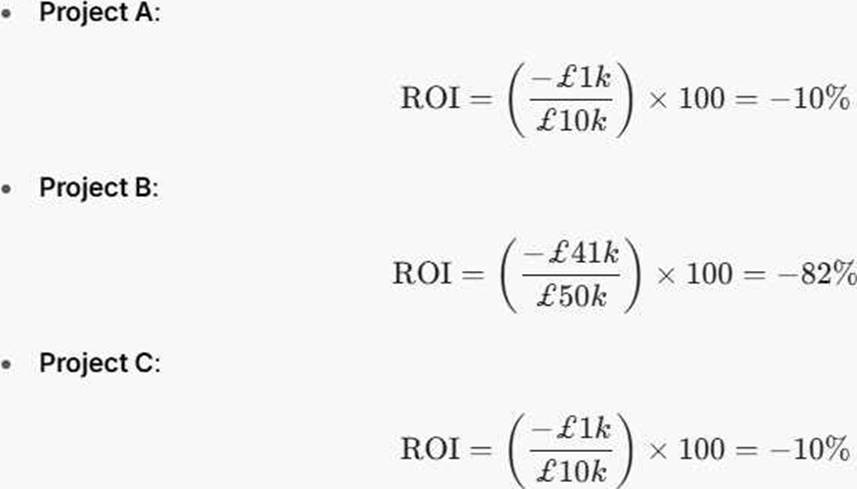
Step 4: Compare and Choose:
Project A: -10% ROI
Project B: -82% ROI
Project C: -10% ROI
All projects show a negative ROI, meaning none generate a profit over the investment cost. However, Projects A and C have the least negative ROI at -10%, while Project B is significantly worse at -82%. Between A and C, the ROI is identical, but both require the same investment (£10k) and yield the same returns. Therefore, there is no financial difference between A and C based on ROI alone. However, since the question asks for a choice, John should choose either Project A or Project C over Project B, as they minimize losses. Without additional qualitative factors (e.g., strategic fit, risk), either A or C is equally viable. For simplicity, let’s recommend Project A.
Recommendation: John should choose Project A (or C), as it has a less negative ROI (-10%) compared to Project B (-82%), indicating a smaller financial loss. Exact Extract Explanation
Part 1: What is Return on Investment?
The CIPS L5M4 Advanced Contract and Financial Management study guide explicitly covers ROI in the context of financial management tools for evaluating contract or project performance. It defines ROI as "a measure of the gain or loss generated on an investment relative to the amount invested," typically expressed as a percentage. The guide positions ROI as a fundamental metric for assessing "value for money," a core principle of L5M4, especially when selecting projects or suppliers. Detailed Explanation
The guide explains that ROI is widely used because it provides a "clear financial snapshot" of investment performance. In John’s case, ROI helps compare the profitability of three projects. It also notes that ROI is often used in contract management to evaluate supplier performance or project outcomes, ensuring resources are allocated efficiently.
Part 2: Benefits and Disadvantages
The study guide discusses ROI’s role in financial decision-making, highlighting its strengths and limitations, particularly in contract and project evaluations. Benefits:
Simplicity and Clarity:
Chapter 4 notes that ROI’s "ease of calculation" makes it accessible for quick assessments, ideal for John’s scenario.
Focus on Financial Efficiency:
The guide emphasizes ROI’s alignment with "maximizing returns," ensuring investments like John’s
projects deliver financial value.
Comparability:
ROI’s percentage format allows "cross-project comparisons," per the guide, enabling John to evaluate projects with different investment levels. Disadvantages:
Ignores Time Value of Money:
The guide warns that ROI "does not consider the timing of cash flows," a critical limitation. For John, returns in Year 3 are less valuable than in Year 1 due to inflation or opportunity costs. Excludes Non-Financial Factors:
L5M4 stresses that financial metrics alone can miss "strategic benefits" like quality or innovation, which might apply to John’s projects.
Potential for Misleading Results:
The guide cautions that ROI can be "distorted" if costs or profits are misreported, a risk John should
consider if project data is incomplete.
Part 3: Which Option Should John Choose?
The guide’s focus on ROI as a decision-making tool directly supports the calculation process above. It advises using ROI to "rank investment options" but also to consider broader factors if results are close, as seen with Projects A and C.
Analysis:
The negative ROIs indicate all projects are unprofitable, a scenario the guide acknowledges can occur, suggesting further analysis (e.g., risk, strategic fit). However, based solely on ROI, A and C are better than B.
The guide’s emphasis on minimizing financial loss in poor-performing investments supports choosing
A or C, as they have the least negative impact.
Reference: CIPS L5M4 Study Guide, Chapter 4: Financial Management in Contracts, Section on Financial Metrics and Investment Appraisal.
Additional
Reference: Chapter 2: Performance Management in Contracts, Section on Decision-Making Tools.
SIMULATION
What are KPIs and why are they used? Give examples.
KPIs are specific, measurable indicators that reflect progress toward strategic or operational goals.
They differ from general metrics by being directly tied to critical success factors in a contract or financial context.
Characteristics of Effective KPIs:
Specific: Clearly defined to avoid ambiguity (e.g., "on-time delivery" rather than "good service").
Measurable: Quantifiable in numerical terms (e.g., percentage, cost, time).
Achievable: Realistic within the contract’s scope and resources.
Relevant: Aligned with the contract’s purpose and organizational goals.
Time-bound: Measured within a specific timeframe (e.g., monthly, quarterly).
Why KPIs Are Used:
Performance Monitoring: Track supplier or contractor adherence to agreed terms.
Risk Management: Identify deviations early to mitigate potential issues (e.g., delays or cost overruns).
Financial Control: Ensure budgets are adhered to and cost efficiencies are achieved.
Accountability: Hold parties responsible for meeting agreed standards.
Continuous Improvement: Provide data to refine processes and enhance future contracts.
Examples of KPIs:
Operational KPI: Percentage of On-Time Deliveries C Measures the supplier’s ability to deliver goods or services within agreed timelines (e.g., 98% of shipments delivered on schedule).
Financial KPI: Cost Variance C Compares actual costs to budgeted costs (e.g., staying within 5% of the allocated budget).
Quality KPI: Defect Rate C Tracks the proportion of defective items or services (e.g., less than 1% defects in a production batch).
Service KPI: Response Time C Evaluates how quickly a supplier addresses issues (e.g., resolving complaints within 24 hours).
Sustainability KPI: Carbon Footprint Reduction C Measures environmental impact (e.g., 10%
reduction in emissions from logistics).
Exact Extract Explanation
The CIPS L5M4 Advanced Contract and Financial Management study guide positions KPIs as a cornerstone of effective contract management. According to the guide, KPIs are "quantifiable measures that allow organizations to assess supplier performance against contractual obligations and financial targets." They are not arbitrary metrics but are carefully selected to reflect the contract’s priorities, such as cost efficiency, quality, or timely delivery. The guide stresses that KPIs must be agreed upon by all parties during the contract negotiation phase to ensure mutual understanding and commitment.
Detailed Purpose:
Monitoring and Evaluation: Chapter 2 of the study guide explains that KPIs provide "a systematic approach to monitoring performance," enabling managers to track progress in real-time and compare it against benchmarks. For example, a KPI like "percentage of invoices paid on time" ensures financial discipline.
Decision-Making: KPIs offer data-driven insights, allowing contract managers to decide whether to escalate issues, renegotiate terms, or terminate agreements. The guide notes, "KPIs highlight variances that require corrective action."
Value for Money: The financial management aspect of L5M4 emphasizes KPIs as tools to ensure contracts deliver economic benefits. For instance, a KPI tracking "total cost of ownership" helps assess long-term savings beyond initial costs.
Risk Mitigation: By setting thresholds (e.g., maximum acceptable delay), KPIs act as early warning systems, aligning with the guide’s focus on proactive risk management. Practical Application:
The guide provides examples like "schedule performance index" (SPI), which measures progress against timelines, and "cost performance index" (CPI), which evaluates budget efficiency. These are often expressed as ratios (e.g., SPI > 1 indicates ahead of schedule).
Another example is "service level agreements" (SLAs), where KPIs such as "uptime percentage" (e.g., 99.9% system availability) are critical in IT contracts.
In a procurement context, KPIs like "supplier lead time" (e.g., goods delivered within 7 days) ensure supply chain reliability.
Why They Matter:
The study guide underscores that KPIs bridge the gap between contract terms and actual outcomes. They transform abstract goals (e.g., "improve quality") into concrete targets (e.g., "reduce defects by 15%"). This alignment is vital for achieving strategic objectives, such as cost reduction or customer satisfaction.
KPIs also facilitate stakeholder communication by providing a common language to discuss performance. For instance, a KPI report showing "90% compliance with safety standards" reassures clients and regulators alike.
Broader Implications:
In complex contracts, KPIs may be tiered (e.g., primary KPIs for overall success and secondary KPIs for specific tasks). The guide advises balancing quantitative KPIs (e.g., cost savings) with qualitative ones (e.g., customer feedback scores) to capture a holistic view.
Regular review of KPIs is recommended to adapt to changing circumstances, such as market fluctuations or new regulations, ensuring they remain relevant throughout the contract lifecycle.
Reference: CIPS L5M4 Study Guide, Chapter 2: Performance Management in Contracts, Section on Key Performance Indicators.
Additional
Reference: Chapter 4: Financial Management in Contracts, Section on Measuring Financial Performance.