
The Open Group OGEA-101 Practice Exams
Last updated on Oct 21,2026- Exam Code: OGEA-101
- Exam Name: TOGAF Enterprise Architecture Part 1 Exam (English)
- Certification Provider: The Open Group
- Latest update: Oct 21,2026
Which of the following is the ability to develop use and sustain the architecture of a particular enterprise using architecture to govern change?
- A . An EA Capability
- B . An EA repository
- C . An EA framework
- D . An Enterprise Architecture
A
Explanation:
The ability to develop, use, and sustain the architecture of a particular enterprise using architecture to govern change is an EA Capability. An EA Capability is a set of skills, processes, roles, responsibilities, tools, and techniques that enable an enterprise to successfully develop and maintain its Enterprise Architecture and achieve its desired outcomes. An EA Capability is part of an enterprise’s overall capability portfolio and should be aligned with its strategy and objectives.
Reference: The TOGAF® Standard | The Open Group Website, Section 3.2 Preliminary Phase.
Which of the following statements about architecture partitioning is correct?
- A . Partitions are used to simplify the management of the Enterprise Architecture.
- B . Partitions are equivalent to architecture levels.
- C . Partitions reflect the organization’s structure.
- D . Partitions are defined and assigned to agile Enterprise Architecture teams.
A
Explanation:
Based on the web search results, architecture partitioning is a technique that divides the Enterprise Architecture into smaller and manageable segments or groups, based on various classification criteria, such as subject matter, time, maturity, volatility, etc.12 Architecture partitioning is used to simplify the development and management of the Enterprise Architecture, by reducing complexity, improving governance, enhancing reusability, and increasing alignment and agility12. Therefore, the statement that partitions are used to simplify the management of the Enterprise Architecture is correct.
The other statements are incorrect because:
• Partitions are not equivalent to architecture levels. Architecture levels are different layers of abstraction that describe the Enterprise Architecture from different perspectives, such as strategic, segment, and capability3. Partitions are subsets of architectures that are defined within or across the levels, based on specific criteria1.
• Partitions do not necessarily reflect the organization’s structure. The organization’s structure is one possible criterion for partitioning the architecture, but it is not the only one. Other criteria, such as business function, product, service, geography, etc., can also be used to partition the architecture12.
• Partitions are not defined and assigned to agile Enterprise Architecture teams. Agile Enterprise Architecture is an approach that applies agile principles and practices to the architecture work, such as iterative development, frequent feedback, adaptive planning, and continuous delivery4. Partitions are not a specific feature of agile Enterprise Architecture, but a general technique that can be applied to any architecture method or framework, including TOGAF12.
Reference: 1: The TOGAF Standard, Version 9.2 – Architecture Partitioning 2: TOGAF® Standard ― Introduction – Architecture Partitioning 3: [The TOGAF Standard, Version 9.2 – Applying the ADM Across the Architecture Landscape] 4: TOGAF® Standard ― Introduction – Definitions – The Open Group
Which of the following best describes purpose of the Business Scenarios?
- A . To identify risk when implementing an architecture project
- B . To identify and understand requirements
- C . To catch errors in a project architecture early
- D . To guide decision making throughout the enterprise
B
Explanation:
Business scenarios are a technique for capturing, clarifying, and communicating the functional and non-functional requirements of a system. Business scenarios describe the business environment, the actors involved, the desired outcomes, and the processes or rules that govern the behavior of the system. Business scenarios are useful for ensuring that the architecture addresses the real needs and concerns of the stakeholders, and for validating and testing the architecture against expected situations. Business scenarios are developed in Phase A: Architecture Vision of the ADM cycle, and refined and updated throughout the other phases3
Reference: 3: The TOGAF Standard, Version 9.2, Part III: ADM Guidelines and Techniques, Chapter 26: Business Scenarios: The TOGAF Standard, Version 9.2, Part II: Architecture Development Method (ADM), Chapter 18: Phase A: Architecture Vision
Consider the following ADM phases objectives.
Objective
1- Determine whether an incremental approach is required, and if so identify Transition Architectures that will deliver continuous business value
2- Generate the initial complete version of the Architecture Roadmap, based upon the gap analysis and candidate Architecture Roadmap components from Phases B, C, and D
3- Finalize the Architecture Roadmap and the supporting Implementation and Migration Plan
4- Ensure that the business value and cost of work packages and Transition Architectures is understood by key stakeholders
Which phase does each objective match?
- A . 1E-2F-3E-4F
- B . 1G-2E-3F-4F
- C . 1E-2E-3F-4F
- D . 1F-2E-3F-4G
B
Explanation:
According to the TOGAF standard, the objectives of each ADM phase are as follows1:
• Phase E: Opportunities and Solutions
o Determine whether an incremental approach is required, and if so identify Transition Architectures that will deliver continuous business value
o Identify and group major work packages within the Architecture Roadmap
o Identify and group major implementation projects to realize the Architecture Roadmap
o Identify dependencies between increments and projects
o Estimate cost, benefit, and risk at a high level for each increment and project
o Conduct initial prioritization and sequencing of the Architecture Roadmap and projects
• Phase F: Migration Planning
o Generate the initial complete version of the Architecture Roadmap, based upon the gap analysis and candidate Architecture Roadmap components from Phases B, C, and D
o Confirm the Transition Architectures with relevant stakeholders
o Create the Implementation and Migration Plan, including Transition Architectures, work packages, projects, and other activities
o Confirm and agree the Architecture Roadmap and Implementation and Migration Plan with relevant stakeholders
• Phase G: Implementation Governance
o Finalize the Architecture Roadmap and the supporting Implementation and Migration Plan
o Ensure conformance with the Target Architecture by implementation projects
o Perform appropriate Architecture Governance functions for the solution and any implementation-driven architecture Change Requests
o Ensure that the architecture lifecycle is maintained
o Ensure that the Architecture Governance Framework is executed
• Phase H: Architecture Change Management
o Ensure that the business value and cost of work packages and Transition Architectures is understood by key stakeholders
o Manage risks and issues related to the Architecture Roadmap and Implementation and Migration Plan
o Monitor the implementation projects and Transition Architectures
o Manage changes to the architecture baseline
o Manage changes to the Architecture Capability
Therefore, the correct matching of the objectives and the phases is:
• 1G: Determine whether an incremental approach is required, and if so identify Transition Architectures that will deliver continuous business value
• 2E: Generate the initial complete version of the Architecture Roadmap, based upon the gap analysis and candidate Architecture Roadmap components from Phases B, C, and D
• 3F: Finalize the Architecture Roadmap and the supporting Implementation and Migration Plan
• 4F: Ensure that the business value and cost of work packages and Transition Architectures is understood by key stakeholders
Reference: 1: The TOGAF Architecture Development Method
Complete the sentence. The key purpose of Gap Analysis is to _____
- A . establish quality parameters for the architecture
- B . identify potential missing or overlapping functions
- C . validate nonfunctional requirements
- D . identify commercial building blocks to be purchased
- E . determine the required service levels for the architecture
B
Explanation:
Gap Analysis is a technique that compares the Baseline Architecture and the Target Architecture to identify the differences and gaps between them. The purpose of this technique is to determine the changes and additions that are required to achieve the desired future state of the architecture. One of the main aspects of Gap Analysis is to identify the functions that are missing or overlapping in the current and future architectures, and to plan how to address them. This helps to ensure that the architecture is complete, consistent, and aligned with the business objectives and requirements3
Which of the following best describes the need for the ADM process to be governed?
- A . To enable development of reference architectures
- B . To verify that the method is being applied correctly
- C . To enable a fast response to market changes
- D . To permit the architecture domains to be integrated
B
Explanation:
According to the TOGAF standard, the need for the ADM process to be governed is to ensure that the architecture development and implementation activities are conducted in a consistent, coherent, and compliant manner1. Governance provides the means to verify that the method is being applied correctly and effectively, and that the architecture deliverables and artifacts meet the quality and standards criteria1. Governance also enables the management of risks, issues, changes, and dependencies that may arise during the ADM process1.
Some of the benefits of governing the ADM process are2:
• Improved alignment of the architecture with the business strategy and objectives
• Enhanced stakeholder engagement and communication
• Increased reuse and integration of architecture assets and resources
• Reduced complexity and duplication of architecture efforts
• Increased agility and adaptability of the architecture to changing needs and requirements
• Improved compliance and auditability of the architecture outcomes and outputs
Reference: 1: Architecture Governance 2: Architecture Governance Benefits
Consider the image showing basic architectural concepts.
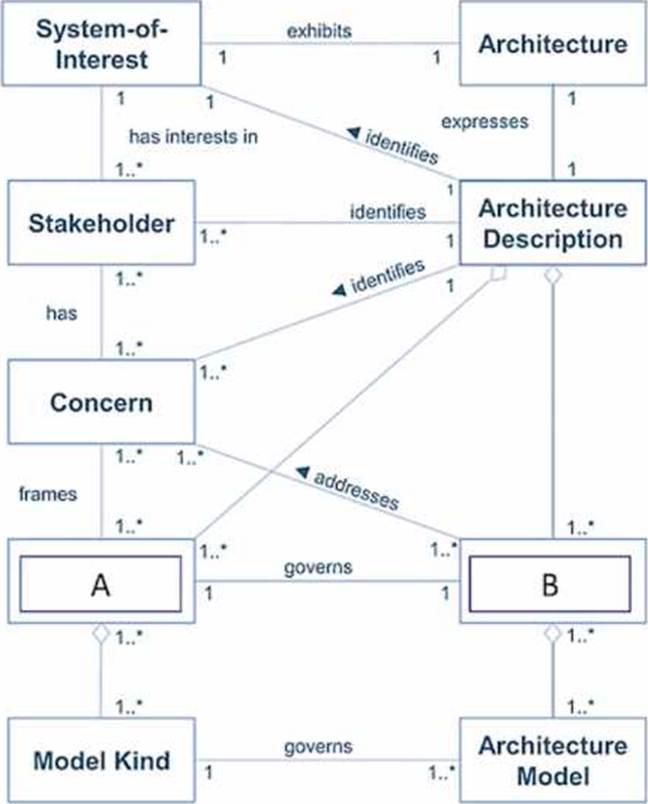
What are items A and B?
- A . A-Architecture Viewpoint, B-Architecture View
- B . A-Architecture Board, B-Architecture Capability
- C . A-Candidate Architecture, B-Trade-off
- D . A-Requirement. B-Candidate Architecture
A
Explanation:
The image shows a diagram that illustrates the basic concepts of architecture description as defined by the ISO/IEC/IEEE 42010:2011 standard1, which is also adopted by the TOGAF standard2.
According to the ISO/IEC/IEEE 42010:2011 standard, an architecture description is a work product used to express an architecture, and it consists of one or more architecture views1.
An architecture view is a representation of a system from the perspective of a related set of concerns, and it conforms to an architecture viewpoint1.
An architecture viewpoint is a specification of the conventions for constructing and using an architecture view to address specific stakeholder concerns1.
Therefore, the correct answer is option A, which identifies the items labeled as “A” and “B” in the image as an architecture viewpoint and an architecture view, respectively.
Reference:
1: ISO/IEC/IEEE 42010:2011 – Systems and software engineering ― Architecture description1
2: TOGAF Standard, Version 9.2 – Part IV: Architecture Content Framework – 31. Architectural Artifacts2
Complete the sentence The Enterprise Continuum provides methods for classifying architecture artifacts as they evolve from________________________.
- A . Solutions Architectures to Solution Building Blocks
- B . generic architectures to reusable Solution Building Blocks
- C . Foundation Architectures to re-usable architecture assets
- D . generic architectures to Organization-Specific Architectures
D
Explanation:
The Enterprise Continuum provides methods for classifying architecture artifacts as they evolve from generic architectures to Organization-Specific Architectures. Generic architectures are architectures that have been developed for use across a wide range of enterprises with similar characteristics. They provide common models, functions, and services that can be reused and adapted for specific purposes. Organization-Specific Architectures are architectures that have been tailored to meet the needs and requirements of a particular enterprise or a major organizational unit within an enterprise. They reflect the unique vision, goals, culture, structure, processes, systems, and technologies of that enterprise or unit.
Reference: The TOGAF® Standard | The Open Group Website, Section 2.3 Enterprise Continuum.
Consider the following ADM phases objectives.
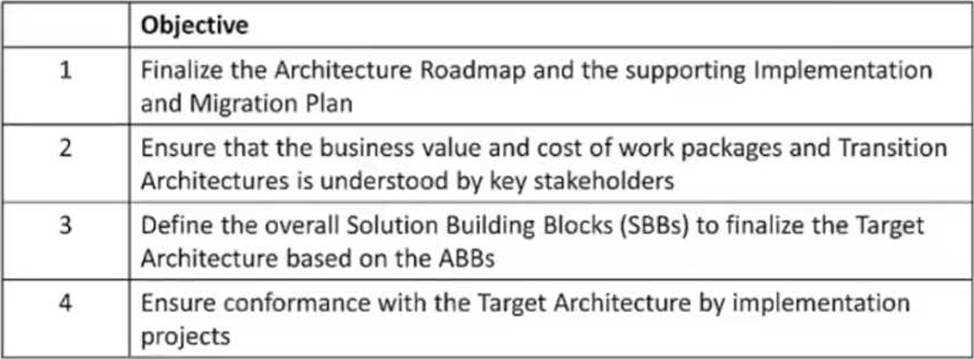
Which phase does each objective match?
- A . 1F-2G-3F-4F
- B . 1E-2F-3E-4G
- C . 1G-2E-3F-4E
- D . 1F-2F-3E-4G
B
Explanation:
1E: To identify delivery vehicles (projects programs portfolios) that will deliver the Target Architecture 2F: To confirm readiness and ability to undergo change 3E: To determine whether an incremental approach is required and if so identify Transition Architectures that will deliver continuous business value 4G: To perform appropriate governance functions while the solution is being implemented
Reference: The TOGAF® Standard | The Open Group Website, Section 3.2 ADM Phases.
What are the following activities part of?
• Initial risk assessment
• Risk mitigation and residual risk assessment
• Risk monitoring
- A . Risk Management
- B . Phase A
- C . Security Architecture
- D . Phase C
A
Explanation:
The following activities are part of Risk Management:
– Initial risk assessment
– Risk mitigation and residual risk assessment
– Risk monitoring
Risk Management is the process of identifying, assessing, and responding to risks that may affect the achievement of the enterprise’s objectives. Risk Management involves balancing positive and negative outcomes resulting from the realization of either opportunities or threats.
Reference: The TOGAF® Standard | The Open Group Website, Section 3.3.3 Risk Management.