
Network Appliance NS0-521 Practice Exams
Last updated on Oct 21,2026- Exam Code: NS0-521
- Exam Name: Implementation Engineer - SAN ONTAP Exam
- Certification Provider: Network Appliance
- Latest update: Oct 21,2026
An administrator runs the vserver nvme namespace convert-from-iun command on a NetApp ASA cluster to increase host performance.
What is modified by the convert command?
- A . FlexVol
- B . FlexClone
- C . LUN clone
- D . Metadata
D
Explanation:
The vserver nvme namespace convert-from-lun command in a NetApp ASA cluster is used to convert a LUN to an NVMe namespace to increase host performance. This process involves modifying the metadata of the storage object to make it compatible with the NVMe protocol, allowing for faster access and reduced latency
Which NetApp feature presents LUNs only within the HA pair?
- A . Selective LUN Mapping
- B . Subsystem
- C . Consistency group
- D . igroup
A
Explanation:
Selective LUN Mapping (SLM) is the feature that presents LUNs only within the HA pair. SLM allows administrators to control which LUNs are visible to which hosts, ensuring that LUNs are only accessible through the designated HA pair, thus improving security and manageability.
For more information, see:
NetApp Documentation on Selective LUN Mapping
NetApp Community on LUN Mapping
What needs to be done to create a consistent Snapshot copy of a LUN without disruptions?
- A . Ensure that the LUN is the only one in the volume.
- B . Quiesce I/O to the LUN.
- C . Ensure that the LUN Is unmapped from the host.
- D . Map the LUN to a host.
B
Explanation:
To create a consistent Snapshot copy of a LUN without disruptions, it is necessary to quiesce I/O to the LUN. This process involves pausing or temporarily stopping the input/output operations to ensure that the data is in a consistent state when the snapshot is taken. This method is crucial for maintaining data integrity and consistency in the snapshot.
For further details, refer to:
NetApp Documentation on Snapshot Consistency
NetApp Best Practices for Snapshot Management
When using FCP, what is the minimum number of FC switches needed to redundantly attach three ESXi hosts?
- A . 0
- B . 1
- C . 2
- D . 4
C
Explanation:
When using Fibre Channel Protocol (FCP), the minimum number of FC switches needed to redundantly attach three ESXi hosts is 2. This setup ensures that each host has multiple paths to the storage, providing high availability and fault tolerance. Each ESXi host should be connected to both switches, allowing for continuous operation even if one switch fails.
For more information, refer to:
NetApp Documentation on FC Switch Configurations
NetApp Community Discussion on Redundant FC Setup
A customer wants to Implement a NetApp AFF system at a small remote site that has two ESXi servers that require SAN storage from the NetApp ONTAP based storage system. The servers will be directly connected, because the customer does not want to deploy any switches.
Which protocol should the customer use?
- A . FCP
- B . NFS
- C . FCoE
- D . iSCSI
D
Explanation:
For a small remote site with two ESXi servers requiring SAN storage and no switches, the recommended protocol is iSCSI. iSCSI allows for direct connectivity between the servers and the NetApp ONTAP storage system using standard Ethernet infrastructure, which is suitable for environments without Fibre Channel switches.
For more information, see:
NetApp iSCSI Configuration Guide
Click the Exhibit button.
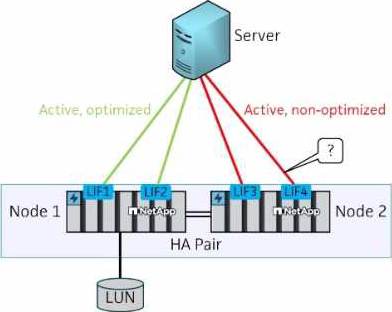
A customer is testing a newly installed NetApp AFF A400 all-flash HA storage system. An SVM for FCP with a LUN on Node 1 has been configured, and a server has been connected as shown in the exhibit. For testing, the engineer plans to do a storage failover of Node 1.
After the failover, what is the expected status of the marked path?
- A . Unavailable
- B . Active/Optimized
- C . Active/Nonoptimized
- D . Offline
C
Explanation:
In the scenario where a storage failover is performed on Node 1 in an HA pair, the path marked in the exhibit would become Active/Nonoptimized. After the failover, the LIFs from Node 1 that were active and optimized will switch to Node 2. Paths that were previously optimized will become nonoptimized because they are now served through the partner node.
For more details, see:
NetApp Documentation on ALUA
On a two-node NetApp AFF ASA cluster, what is the recommended minimum number of paths for a SAN environment from the client host perspective?
- A . 2
- B . 8
- C . 4
- D . 16
C
Explanation:
In a two-node NetApp AFF ASA cluster, the recommended minimum number of paths for a SAN environment from the client host perspective is 4. This configuration ensures high availability and load balancing, which are critical for maintaining performance and resilience in a SAN environment. Each host should have at least two paths to each controller to achieve this setup.
For more detailed information, you can refer to:
NetApp SAN Configuration
NetApp All-Flash SAN Array Documentation
When using tagged VLANs on Cisco Nexus switches for NVMe over TCP, which two changes must be made to enable jumbo frames? (Choose two.)
- A . Modify the Cisco Nexus switches to use an MTU of 9216.
- B . Modify the appropriate broadcast domain in NetApp ONTAP software to use an MTU of 9000.
- C . Modify the appropriate broadcast domain in NetApp ONTAP software to use an MTU of 9216.
- D . Modify the Cisco Nexus switches to use an MTU of 9000.
AC
Explanation:
For enabling jumbo frames on Cisco Nexus switches for NVMe over TCP with tagged VLANs, the following changes are required:
Modify the Cisco Nexus switches to use an MTU of 9216: Setting the MTU to 9216 ensures that the network can handle jumbo frames, reducing the number of packets needed for large data transfers and thus improving performance.
Modify the appropriate broadcast domain in NetApp ONTAP software to use an MTU of 9216: This setting must match the network configuration to ensure end-to-end support for jumbo frames, which is essential for optimizing performance in NVMe over TCP environments.
For additional information, refer to:
NetApp Documentation on NVMe over TCP
Cisco Documentation on Jumbo Frames
What is the minimum number of rack units that are required on each site for a NetApp AFF All San Array (ASA) A800 MetroCluster IP configuration with 72 disks per site and Cisco N9K-C9336C-FX2 backend switches?
- A . 16 RU
- B . 8RU
- C . 12 RU
- D . 4RU
A
Explanation:
For a NetApp AFF All SAN Array (ASA) A800 MetroCluster IP configuration with 72 disks per site and Cisco N9K-C9336C-FX2 backend switches, the minimum number of rack units required on each site is 16 RU. This includes space for the controllers, disk shelves, and the necessary network switches. This configuration ensures that all components are properly accommodated and operational within the specified rack space.
For detailed information on the rack unit requirements and MetroCluster IP configurations, refer to:
NetApp Documentation on MetroCluster IP
MetroCluster IP Solution Architecture
An administrator creates a new volume and a LUN for an SAN-connected application that uses snapshots. The application has fast-growing data that is constantly being populated and deleted afterwards.
Which option can be set to manage the space automatically?
- A . Enable automatic resizing on the volume.
- B . Enable space reservation on the LUN.
- C . Disable volume snapshot autodelete.
- D . Unmap the LUN.
A
Explanation:
To manage space automatically for a volume containing a LUN with fast-growing data, enabling automatic resizing on the volume is recommended. This feature allows the volume to grow dynamically as needed, accommodating the fluctuating data size without manual intervention. This helps in managing storage efficiently and ensures that the application has the required space.
For further details, refer to:
NetApp Documentation on Volume Management
NetApp Community Discussion on Automatic Resizing