
PECB ISO-IEC-27005 Risk Manager Practice Exams
Last updated on Oct 21,2026- Exam Code: ISO-IEC-27005 Risk Manager
- Exam Name: PECB Certified ISO/IEC 27005 Risk Manager
- Certification Provider: PECB
- Latest update: Oct 21,2026
Texas H&H Inc. decided to assign an internal expert for their forensic analysis. Is this acceptable? Refer lo scenario 7.
- A . Yes. forensic analysis can be done by cither an internal or external expert
- B . Yes. hiring an external expert for forensic analysis Is a requirement of the standard
- C . No. the company’s forensic analysis should be based on the conclusion of Its cloud storage provide investigation
Activity area 4: The organization identifies and evaluates the risks. In addition, the criteria specified in activity area 1 is reviewed and the consequences of the areas of concerns are evaluated. Lastly, the level of identified risks is determined.
The table below provides an example of how Biotide assesses the risks related to its information assets following this methodology:
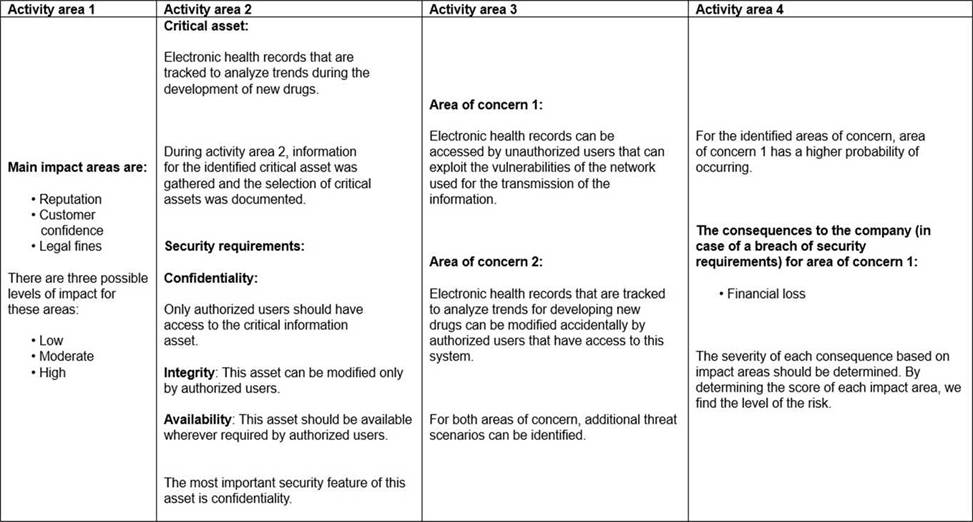
Based on the table provided in scenario 8, did Biotide follow all the steps of the risk assessment methodology regarding the identification of assets?
- A . No, Biotide should identify only critical assets and electronic health records is not a critical asset
- B . No, after identifying critical assets, Biotide should define the asset owners
- C . Yes, the identification of assets involves only the identification of critical information assets and their security requirements
B
Explanation:
Based on the scenario, Biotide follows a methodology where the identification of critical assets is part of Activity Area 2. However, according to ISO/IEC 27005, after identifying the critical assets, the organization should also identify and document the asset owners.
ISO/IEC 27005:2018 emphasizes that the asset owner is responsible for the protection of the asset and that understanding ownership is critical to implementing effective risk management controls. In the given table, the scenario does not explicitly mention defining the asset owners after identifying critical assets, which is a necessary step. Therefore, the correct answer is B.
Reference: ISO/IEC 27005:2018, Section 7.2.2 "Identification of assets, owners, and risk sources" details the steps required for proper asset identification, including defining the asset owners as a critical part of the risk assessment process.
Which statement regarding information gathering techniques is correct?
- A . Sending questionnaires to a group of people who represent the interested parties is NOT preferred
- B . Organizations can utilize technical tools to identify technical vulnerabilities and compile a list of assets that influence risk assessment
- C . Interviews should be conducted only with individuals responsible for information security management
B
Explanation:
ISO/IEC 27005 supports the use of various information-gathering techniques, including technical tools, to identify and assess risks. Technical tools such as vulnerability scanners and asset management software can help organizations identify technical vulnerabilities and compile a list of assets that are critical for risk assessment. This aligns with the standard’s recommendation to use automated tools for an effective risk assessment process.
Option B is correct because it accurately describes an effective information-gathering technique.
Reference: ISO/IEC 27005:2018, Clause 8.2, "Risk Identification," which discusses using tools and techniques to identify risks.
Scenario 7: Adstry is a business growth agency that specializes in digital marketing strategies. Adstry helps organizations redefine the relationships with their customers through innovative solutions. Adstry is headquartered in San Francisco and recently opened two new offices in New York. The structure of the company is organized into teams which are led by project managers. The project manager has the full power in any decision related to projects. The team members, on the other hand, report the project’s progress to project managers.
Considering that data breaches and ad fraud are common threats in the current business environment, managing risks is essential for Adstry. When planning new projects, each project manager is responsible for ensuring that risks related to a particular project have been identified, assessed, and mitigated. This means that project managers have also the role of the risk manager in Adstry. Taking into account that Adstry heavily relies on technology to complete their projects, their risk assessment certainly involves identification of risks associated with the use of information technology. At the earliest stages of each project, the project manager communicates the risk assessment results to its team members.
Adstry uses a risk management software which helps the project team to detect new potential risks during each phase of the project. This way, team members are informed in a timely manner for the new potential risks and are able to respond to them accordingly. The project managers are responsible for ensuring that the information provided to the team members is communicated using an appropriate language so it can be understood by all of them.
In addition, the project manager may include external interested parties affected by the project in the risk communication. If the project manager decides to include interested parties, the risk communication is thoroughly prepared. The project manager firstly identifies the interested parties that should be informed and takes into account their concerns and possible conflicts that may arise due to risk communication. The risks are communicated to the identified interested parties while taking into consideration the confidentiality of Adstry’s information and determining the level of detail that should be included in the risk communication. The project managers use the same risk management software for risk communication with external interested parties since it provides a consistent view of risks. For each project, the project manager arranges regular meetings with relevant interested parties of the project, they discuss the detected risks, their prioritization, and determine appropriate treatment solutions. The information taken from the risk management software and the results of these meetings are documented and are used for decision-making processes. In addition, the company uses a computerized documented information management system for the acquisition, classification, storage, and archiving of its documents.
Based on scenario 7, Adstry’s project managers hold regular meetings with interested parties to discuss risks and risk treatment solutions.
According to the guidelines of ISO/IEC 27005, is this in compliance with best practices?
- A . Yes, the coordination between project managers and relevant interested parties can be achieved by discussions upon risks and appropriate treatment solutions
- B . Yes, risks can be communicated to and discussed with relevant interested parties only if the project manager decides that it is appropriate to do so
- C . No, risk owners should not communicate or discuss risk treatment options with external interested parties
A
Explanation:
According to ISO/IEC 27005, effective risk management includes communication and consultation with relevant interested parties. Holding regular meetings to discuss risks, their prioritization, and appropriate treatment solutions is a good practice for ensuring that all parties are aware of the risks and involved in the decision-making process for risk treatment. This approach fosters coordination and collaboration, which is essential for managing risks effectively. Therefore, the practice of discussing risks and treatment options with relevant interested parties aligns with best practices, making option A the correct answer.
Reference: ISO/IEC 27005:2018, Clause 7, "Communication and Consultation," which emphasizes the importance of communicating risks and consulting with relevant interested parties.
An internal employee clicks on a link embedded in an email that redirects them to an unsecured website, installing a malware on the device.
The likelihood of occurrence for the first risk scenario was determined as “medium.” One of the main reasons that such a risk could occur was the usage of default accounts and password. Attackers could exploit this vulnerability and launch a brute-force attack. Therefore, Productscape decided to start using an automated “build and deploy” process which would test the software on deploy and minimize the likelihood of such an incident from happening. However, the team made it clear that
the implementation of this process would not eliminate the risk completely and that there was still a low possibility for this risk to occur. Productscape documented the remaining risk and decided to monitor it for changes.
The likelihood of occurrence for the second risk scenario was determined as “medium.” Productscape decided to contract an IT company that would provide technical assistance and monitor the company’s systems and networks in order to prevent such incidents from happening. The likelihood of occurrence for the third risk scenario was determined as “high.” Thus, Productscape decided to include phishing as a topic on their information security training sessions. In addition, Alex reviewed the controls of Annex A of ISO/IEC 27001 in order to determine the necessary controls for treating this risk. Alex decided to implement control A.8.23 Web filtering which would help the company to reduce the risk of accessing unsecure websites. Although security controls were implemented to treat the risk, the level of the residual risk still did not meet the risk acceptance criteria defined in the beginning of the risk assessment process. Since the cost of implementing additional controls was too high for the company, Productscape decided to accept the residual risk. Therefore, risk owners were assigned the responsibility of managing the residual risk.
Based on scenario 6, Productscape decided to accept the residual risk and risk owners were assigned the responsibility of managing this risk.
Based on the guidelines of ISO/IEC 27005, is this acceptable?
- A . Yes, risk owners must be aware of the residual risk and accept the responsibility for managing it
- B . No, risk approvers are responsible for managing the residual risk after accepting it
- C . No, the top management should manage the residual risk
A
Explanation:
ISO/IEC 27005 specifies that once a risk treatment has been applied and residual risk remains, it is essential that the risk owner is aware of this residual risk and accepts the responsibility for managing it. The risk owner is the individual or entity accountable for managing specific risks within the organization. In Scenario 6, Productscape decided to accept the residual risk and assigned risk owners the responsibility for managing it, which is fully compliant with ISO/IEC 27005. Thus, the correct answer is A.
Reference: ISO/IEC 27005:2018, Clause 8.6, "Risk Treatment," which states that risk owners should be aware of and accept responsibility for managing residual risks.
Scenario 5: Detika is a private cardiology clinic in Pennsylvania, the US. Detika has one of the most advanced healthcare systems for treating heart diseases. The clinic uses sophisticated apparatus that detects heart diseases in early stages. Since 2010, medical information of Detika’s patients is stored on the organization’s digital systems. Electronic health records (EHR), among others, include patients’ diagnosis, treatment plan, and laboratory results.
Storing and accessing patient and other medical data digitally was a huge and a risky step for Detik a. Considering the sensitivity of information stored in their systems, Detika conducts regular risk assessments to ensure that all information security risks are identified and managed. Last month, Detika conducted a risk assessment which was focused on the EHR system. During risk identification, the IT team found out that some employees were not updating the operating systems regularly. This could cause major problems such as a data breach or loss of software compatibility. In addition, the IT team tested the software and detected a flaw in one of the software modules used. Both issues were reported to the top management and they decided to implement appropriate controls for treating the identified risks. They decided to organize training sessions for all employees in order to make them aware of the importance of the system updates. In addition, the manager of the IT Department was appointed as the person responsible for ensuring that the software is regularly tested.
Another risk identified during the risk assessment was the risk of a potential ransomware attack. This risk was defined as low because all their data was backed up daily. The IT team decided to accept the actual risk of ransomware attacks and concluded that additional measures were not required. This decision was documented in the risk treatment plan and communicated to the risk owner. The risk owner approved the risk treatment plan and documented the risk assessment results.
Following that, Detika initiated the implementation of new controls. In addition, one of the employees of the IT Department was assigned the responsibility for monitoring the implementation process and ensure the effectiveness of the security controls. The IT team, on the other hand, was responsible for allocating the resources needed to effectively implement the new controls.
Based on scenario 5, the IT team was responsible for allocating the necessary resources to ensure that the new controls are implemented effectively. Is this acceptable?
- A . Yes, the team that is responsible for conducting the risk assessment should ensure that the necessary resources for treating the risk are allocated
- B . No, the organization should allocate the necessary resources to ensure the effective implementation of the risk treatment plan
- C . No, the necessary resources for treating the risk should be allocated in the beginning of the risk assessment process
A
Explanation:
According to ISO/IEC 27005, the team responsible for the risk assessment is often tasked with coordinating the resources necessary to treat identified risks effectively. This includes ensuring that the resources required for implementing risk treatment actions, such as financial, technical, and human resources, are available and allocated appropriately. Option B is incorrect because it is not only the organization that allocates resources, but rather a combined effort involving the risk management team to ensure proper allocation. Option C is incorrect because resources must be managed and allocated continually throughout the risk management process, not just at the beginning.
After creating a plan for outsourcing to a cloud service provider to store their confidential information in cloud, OrgX decided to not pursue this business strategy since the risk of doing so was high .
Which risk treatment option did OrgX use?
- A . Risk avoidance
- B . Risk sharing
- C . Risk modification
A
Explanation:
OrgX decided not to pursue a business strategy involving outsourcing to a cloud service provider due to the high risk. This decision reflects a "risk avoidance" strategy, where the organization chooses not to engage in an activity that poses unacceptable risks. This aligns with option A.